
About Us
Why the Cheapest Balloon Quote Is Often Your Most Expensive Sourcing Mistake
Views : 312
Update time : 2025-12-24 16:17:00
Why the Cheapest Balloon Quote Is Often Your Most Expensive Sourcing Mistake
If you’ve been sourcing balloons for a while, you know the feeling. You’ve sent out your RFQs, and the replies come in.
Same product. Same size. Same artwork.
Yet, one quote sits there, 30% cheaper than everyone else. A quiet voice in your head starts whispering:
“Am I overpaying with my current supplier?”
“Is this factory just more efficient?”
“Should I just try them once? What’s the worst that could happen?”
This article is here to help you answer those questions. In the balloon industry, a "too-good-to-be-true" price is rarely a bargain—it’s usually a red flag.
1. Low Prices Hide Hidden Quality Cuts
What usually gets cut:
Foil Thickness: Using thinner material that looks fine on a desk but leaks within hours of being filled with helium.
Ink Quality: Reducing ink layers, leading to dull colors or "cracking" when the balloon expands.
The Testing Phase: Skipping the 12–24 hour inflation test (the most critical step in QC).
These cuts don’t show up on your invoice. They show up when your goods reach your customers.
2. The "Trial Order" Trap
When a factory wins an order based solely on an ultra-low price, your small "trial" is their lowest priority. Quality control is often minimal because the order isn't strategic for them. You aren't testing the factory at its best; you are testing it at its most indifferent.
When the defects arrive, the damage is already done: late deliveries, refund requests, and hours of "fire-fighting" with your own clients.
3. Balloons Fail at Retail, Not at the Factory
An event decorator is under a deadline and the balloons pop under heat.
A retail customer complains that their birthday balloon deflated overnight.
Saving $0.03 per unit means nothing if:
8–10% of your stock is unsellable.
Retailers demand credit notes for defective batches.
Your brand gets a reputation for "unstable quality."
Margins don’t die on the invoice—they die in the after-sales chaos.
4. Compare "Total Cost," Not Just "Unit Price"
Consistency: "Can you guarantee this exact foil micron thickness for every batch?"
Reliability: "What is your verified defect rate over the last 12 months?"
Peak Performance: "Can you maintain this quality during the Valentine's or Christmas rush?"
A factory that charges a fair price—one that covers proper QC and stable raw materials—actually delivers a lower total cost because you aren't losing money on returns and lost trust.
Comparison: Cheap vs. Stable Sourcing
| Feature | The "Too-Cheap" Quote | A Stable, Long-Term Supplier |
|---|---|---|
| Material | Inconsistent/Thin | High-grade, gas-retention foil |
| QC Process | Visual check only | 100% Inflation & aging tests |
| Peak Season | Likely delays/Quality drops | Priority scheduling & stable output |
| Result | High stress & hidden costs | Predictable profit & happy clients |
Final Thought: Stability is the Real Profit
Anyone can quote a low price once. Very few factories can deliver stable quality, stable pricing, and stable timing year after year. In the balloon business, stability is where the real money is made.At Ricosen, we help you look beyond the surface price to protect your margins and your reputation.
Tired of "price surprises" and quality headaches? Contact us today for a transparent consultation on your next project. Let’s build a supply chain that actually grows your business.
相关新闻
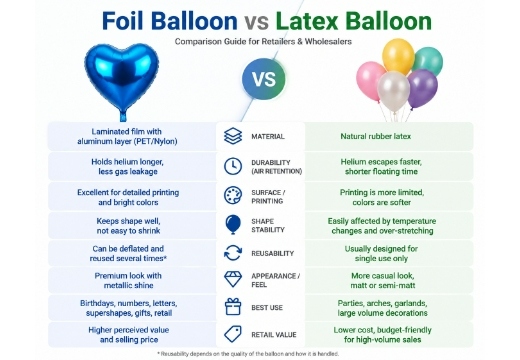 Why Foil Balloons Last Longer Than Latex Balloons: A Durability Comparison Guide
Aug 02,2026
Foil balloons and latex balloons serve different purposes in the balloon industry. This guide explains the key durability differences between foil and latex balloons, including material structure, helium retention, printing performance, reusability, and retail value. Learn why many wholesalers, retailers, and event suppliers choose foil balloons for premium product lines and how selecting the right balloon type can improve customer satisfaction and business profitability.
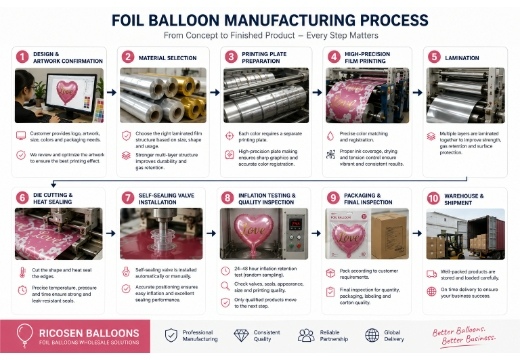 How Are Foil Balloons Made? Inside the Factory: What Happens Before a Foil Balloon Enters Mass Production
Jul 26,2026
Behind every high-quality foil balloon is a carefully controlled manufacturing process. This article takes you inside a professional foil balloon factory, explaining every stage from artwork preparation and material selection to printing, lamination, heat sealing, quality inspection, and final packaging. Learn how each production step influences balloon quality and how buyers can evaluate suppliers beyond price alone.
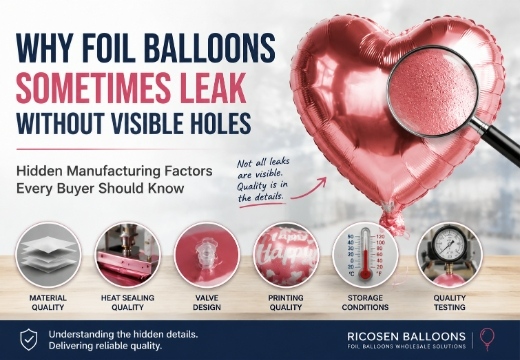 Why Foil Balloons Sometimes Leak Without Visible Holes: Hidden Manufacturing Factors Every Buyer Should Know
Jul 17,2026
Why do foil balloons leak without visible holes? This article explains the hidden manufacturing factors affecting foil balloon durability, including materials, sealing, valves, printing, storage, and quality testing. Learn how professional buyers evaluate suppliers and avoid quality problems.
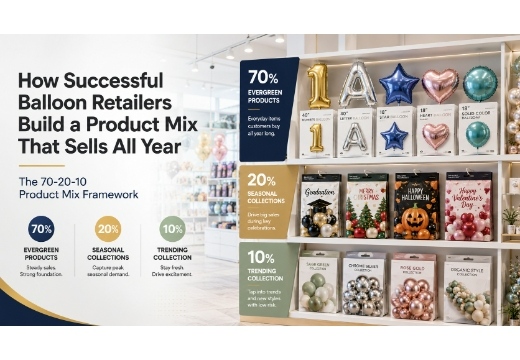 How Successful Balloon Retailers Build a Product Mix That Sells All Year
Jul 10,2026
A successful balloon business isn't built by offering the most products—it's built by offering the right mix of products.
This guide introduces the 70-20-10 Product Mix Framework, a practical approach that helps balloon retailers balance evergreen products, seasonal collections, and trend-driven items for healthier inventory, stronger cash flow, and more consistent year-round sales. Whether you're expanding your product assortment or refining your purchasing strategy, this framework offers actionable insights to build a more profitable retail business.