Oct 3, 2026Retail Sales Tips
Why Some Balloon Products Become Best Sellers While Others Sit on Shelves
Why do some balloon products become best sellers while others sit on shelves? Learn the key factors behind retail balloon sales success, including occasion-based demand, merchandising strategy, col...
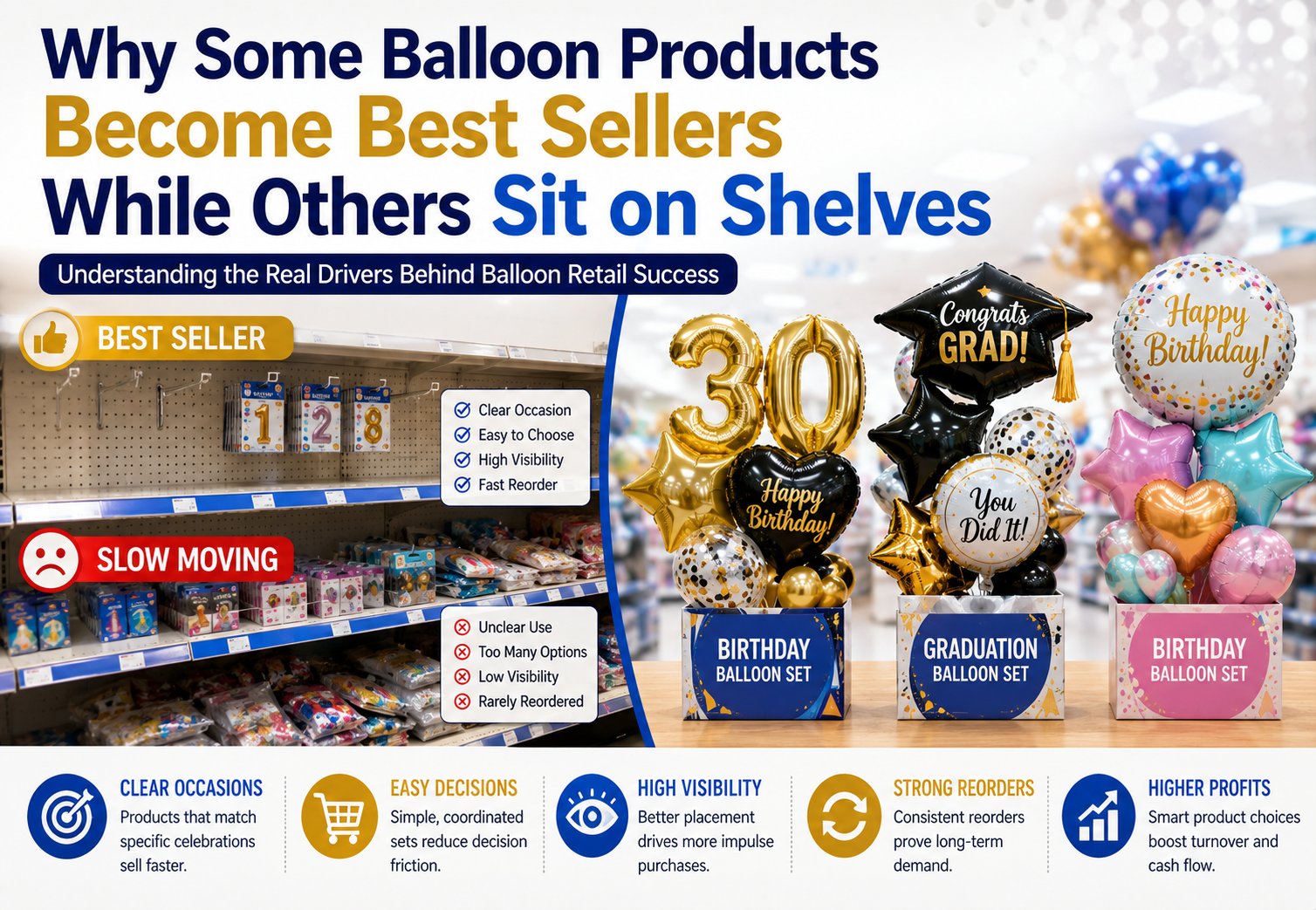
Understanding the Real Drivers Behind Balloon Retail Success
Every retailer has seen this scenario:
Two balloon products arrive at the store at the same time. Both look attractive, both are competitively priced, and both occupy similar shelf space. Yet within just a few weeks, one becomes a fast-moving best seller requiring urgent replenishment, while the other quietly stagnates.
Most buyers assume sales are driven by design alone. In reality, retail performance is determined by operational and behavioral factors far beyond aesthetics.
The best-selling balloon products are not necessarily the most beautiful—they are the ones that reduce decision friction, align with consumer intent, and fit naturally into purchasing occasions.
Understanding these hidden drivers is essential for improving inventory turnover and maintaining healthy cash flow.
Factor 1: Best Sellers Are Built Around Clear Occasions
One of the strongest predictors of retail success is how clearly a product connects to a specific celebration.
Consumers rarely buy balloons. They buy moments.
They are shopping for:
Birthdays and anniversaries
Graduations and academic milestones
Baby showers and weddings
Seasonal holidays like Christmas and Valentine’s Day
The clearer the occasion association, the faster the purchase decision.
This is why jumbo number foil balloons consistently outperform many other categories. The use case is immediately obvious—no explanation needed.
When a product requires customers to figure out how to use it, conversion rates often decline.
Factor 2: Simple, Versatile Designs Outperform Over-Complex Creativity
Many manufacturers invest heavily in novelty shapes and highly specialized designs to stand out.
While innovation has value, retail sales are still dominated by simplicity and versatility.
Core high-performing categories include:
Stars and hearts
Classic numbers and letters
Clean metallic finishes
Standard seasonal shapes
These products succeed because they work across multiple themes, age groups, and occasions.
In contrast, overly specialized designs may attract attention but often struggle to generate consistent sales volume.
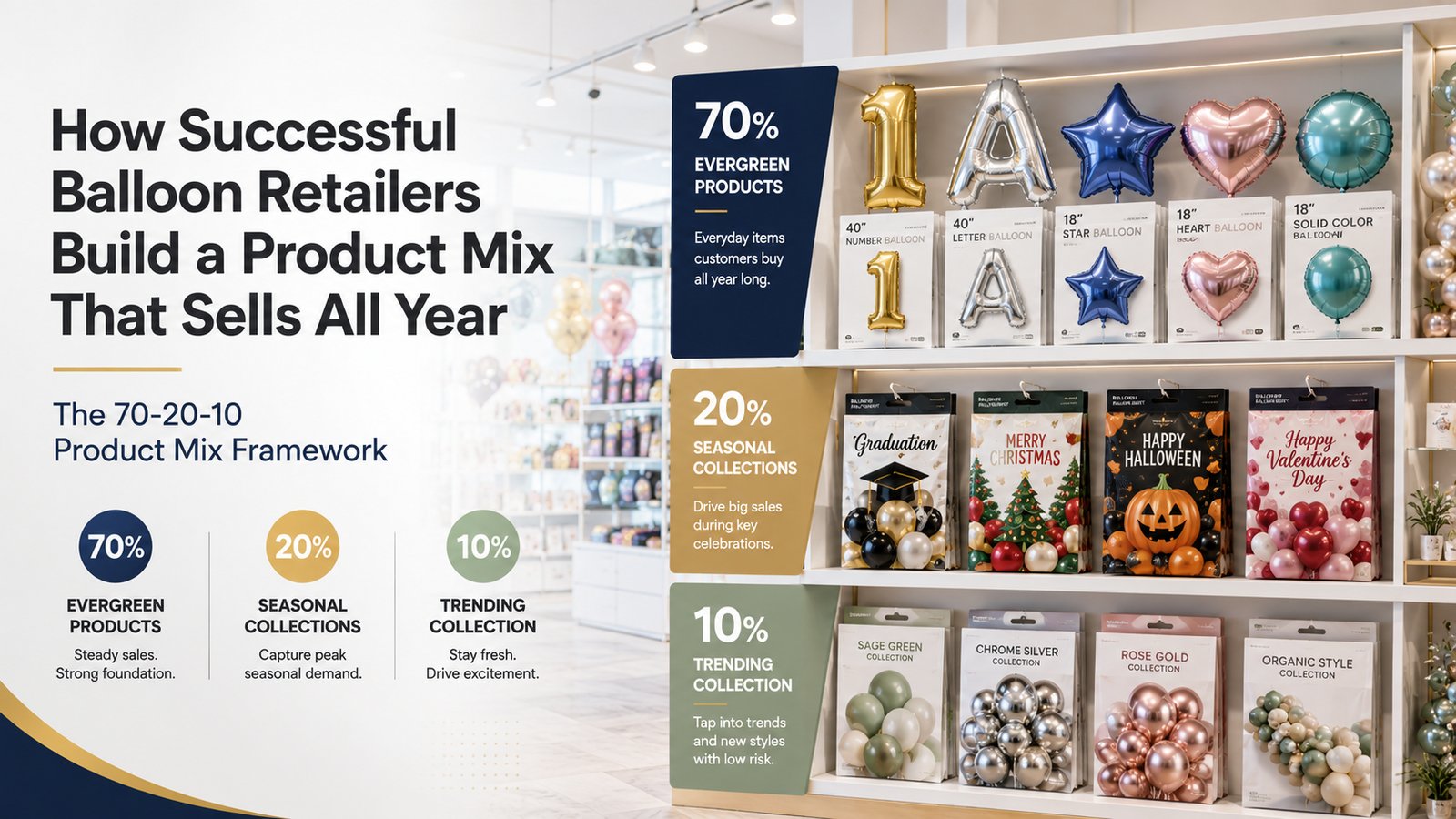
Successful retailers typically anchor their assortment around reliable evergreen products before expanding into experimental lines.
Factor 3: Coordinated Product Sets Increase Basket Value
Treating balloon SKUs as isolated items is one of the most common merchandising mistakes.
In reality, customers do not decorate with a single balloon—they create a complete celebration environment.
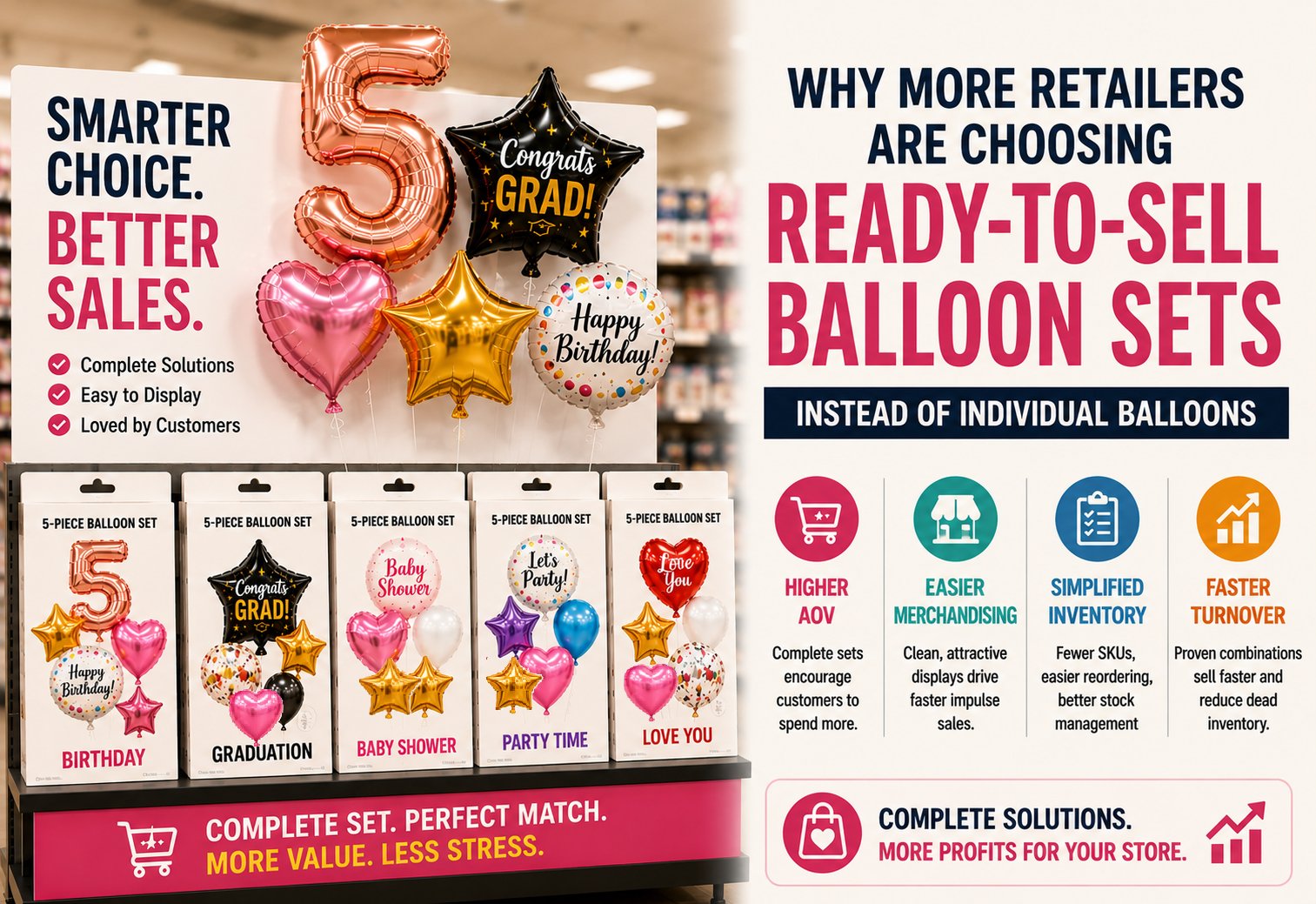
This is why ready-to-sell balloon sets have become a structural advantage in modern retail.
Instead of forcing customers to manually match colors, themes, and proportions, curated kits help:
Reduce decision fatigue
Improve purchase confidence
Increase Average Order Value (AOV)
Many retailers also rely on seasonal balloon sets to simplify merchandising during key holidays and celebration periods.
When products are designed as a complete solution rather than standalone items, customers naturally purchase more per transaction.
Factor 4: Color Trends Are Driven by Social Media Aesthetics
Color often plays a larger role in product performance than many retailers realize.
Modern event styling is heavily influenced by Instagram, Pinterest, TikTok, and party inspiration platforms.
High-performing color categories frequently include:
Luxury-inspired color schemes
Metallic combinations
Soft neutral palettes
Elegant celebration colors
When inventory aligns with current visual trends, perceived value increases immediately—even without changes to the product itself.
Trend-aligned color combinations consistently outperform outdated or mismatched color selections.
Factor 5: In-Store Visibility Directly Impacts Sales Velocity
Retail placement often determines product success as much as product design.
A strong product placed in a low-visibility location may struggle to gain traction, while an average product positioned in a high-traffic area can become a top performer.
Key high-impact placements include:
Checkout counters
Store entrances
Seasonal end-cap displays
To maximize this advantage, retailers increasingly rely on:
Hang-ready packaging
Display-ready products
Fast shelf-replenishment formats
The easier a product is to understand at a glance, the higher its impulse conversion potential.
In many cases, visibility influences sales performance as much as product quality itself.
Factor 6: Reorder Velocity Defines Real Winners
Initial sales spikes can sometimes be misleading, especially during promotions or short-term trends.
The strongest indicator of a winning product is sustained reorder behavior.
Many experienced buyers consider reorder velocity a more reliable indicator than initial sales performance because it reflects genuine consumer demand rather than temporary promotional activity.
Retailers often identify future winners by monitoring fast-turnover balloon products and their replenishment cycles.
Strong SKUs typically show:
Consistent replenishment after peak periods
Stable demand across multiple months
Predictable reordering patterns
Rather than chasing every new trend, successful retailers focus on products that repeatedly prove themselves through strong reorder activity.
Why Some Products Fail: The Shelf-Sitter Diagnosis
When balloon products fail to sell, the issue is rarely manufacturing quality.
More often, it is a positioning or merchandising problem.
Final Thoughts
In the balloon industry, best sellers are rarely accidents.
They are typically the result of:
Clear occasion targeting
Reduced consumer friction
Trend-aligned color strategies
Strong in-store visibility
Consistent replenishment patterns
Beautiful design may capture attention, but operational intelligence drives revenue.
In most retail environments, products that make buying effortless often outperform products that simply look impressive.