Oct 3, 2026Buying Guides
Why the Cheapest Balloon Quote Is Often Your Most Expensive Sourcing Mistake
Many balloon buyers choose the lowest quote—only to pay more later in defects, delays, and lost trust. Learn how professionals compare real sourcing costs.
If you’ve been sourcing balloons for a while, you know the feeling. You’ve sent out your RFQs, and the replies come in.
Same product. Same size. Same artwork.
Yet, one quote sits there, 30% cheaper than everyone else. A quiet voice in your head starts whispering:
“Am I overpaying with my current supplier?”
“Is this factory just more efficient?”
“Should I just try them once? What’s the worst that could happen?”
This article is here to help you answer those questions. In the balloon industry, a "too-good-to-be-true" price is rarely a bargain—it’s usually a red flag.
1. Low Prices Hide Hidden Quality Cuts
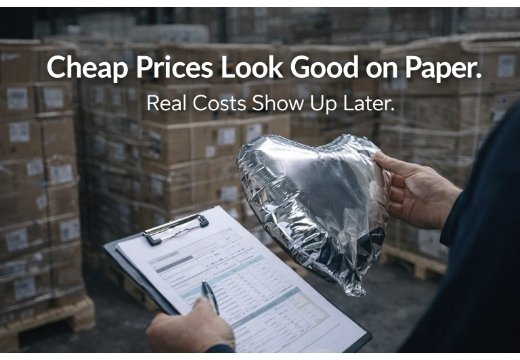
Factories don’t find "magic" ways to cut costs by 30% without changing the recipe. If the price is significantly below the market average, something has been sacrificed.
What usually gets cut:
Foil Thickness: Using thinner material that looks fine on a desk but leaks within hours of being filled with helium.
Ink Quality: Reducing ink layers, leading to dull colors or "cracking" when the balloon expands.
The Testing Phase: Skipping the 12–24 hour inflation test (the most critical step in QC).
These cuts don’t show up on your invoice. They show up when your goods reach your customers.
2. The "Trial Order" Trap
Many buyers think, “I’ll just place a small trial order to test them.” This is a dangerous logic.
When a factory wins an order based solely on an ultra-low price, your small "trial" is their lowest priority. Quality control is often minimal because the order isn't strategic for them. You aren't testing the factory at its best; you are testing it at its most indifferent.
When the defects arrive, the damage is already done: late deliveries, refund requests, and hours of "fire-fighting" with your own clients.
3. Balloons Fail at Retail, Not at the Factory
This is the most painful part of balloon sourcing. Low-quality balloons rarely fail while sitting in a box. They fail when:
An event decorator is under a deadline and the balloons pop under heat.
A retail customer complains that their birthday balloon deflated overnight.
Saving $0.03 per unit means nothing if:
8–10% of your stock is unsellable.
Retailers demand credit notes for defective batches.
Your brand gets a reputation for "unstable quality."
Margins don’t die on the invoice—they die in the after-sales chaos.
4. Compare "Total Cost," Not Just "Unit Price"
Professional buyers have stopped asking "Why are you cheaper?" Instead, they ask:
Consistency: "Can you guarantee this exact foil micron thickness for every batch?"
Reliability: "What is your verified defect rate over the last 12 months?"
Peak Performance: "Can you maintain this quality during the Valentine's or Christmas rush?"
A factory that charges a fair price—one that covers proper QC and stable raw materials—actually delivers a lower total cost because you aren't losing money on returns and lost trust.
Comparison: Cheap vs. Stable Sourcing
• Feature — The "Too-Cheap" Quote — A Stable, Long-Term Supplier
• Material — Inconsistent/Thin — High-grade, gas-retention foil
• QC Process — Visual check only — 100% Inflation & aging tests
• Peak Season — Likely delays/Quality drops — Priority scheduling & stable output
• Result — High stress & hidden costs — Predictable profit & happy clients
Final Thought: Stability is the Real Profit
Anyone can quote a low price once. Very few factories can deliver stable quality, stable pricing, and stable timing year after year. In the balloon business, stability is where the real money is made.
At Ricosen, we help you look beyond the surface price to protect your margins and your reputation.
Tired of "price surprises" and quality headaches? Contact us today for a transparent consultation on your next project. Let’s build a supply chain that actually grows your business.