
About Us
Why Your Foil Balloons Don’t Last (And How to Avoid Costly Quality Mistakes Before You Order)
Views : 271
Update time : 2026-04-09 14:08:00
If you’ve ever tested a batch of foil balloons and noticed they start to soften after just a few days — you’re not alone.
At first glance, everything looks fine.The balloons inflate well, the printing looks good, and the shape holds.
But a few days later:
Some balloons lose firmness
Some look slightly wrinkled
Worst case — your customers complain
And that’s where the real problem begins.
Because this isn’t just about balloons.It’s about your product reputation, customer satisfaction, and repeat sales.
Why Do Foil Balloons Lose Air So Quickly?
Most buyers assume it’s just a “material issue.”But in reality, over 80% of air leakage problems come from production details — not what you see on the surface.
Here are the three factors that actually determine how long a foil balloon lasts:
1. Sealing Quality — The Hidden Weak Point
A foil balloon is only as good as its sealing.Poor heat sealing may not show immediately.But over time, tiny inconsistencies in the sealing line allow air to escape slowly.
That’s why some balloons feel perfect on day one,but noticeably softer after 2–3 days.
This is one of the most common issues in lower-cost production.
2. Valve Design — Where Slow Leaks Begin
The valve (self-sealing part) plays a bigger role than most buyers realize.Low-quality valves may:
Not fully close after inflation
Lose tightness over time
Leak under slight pressure changes (like shipping or temperature shifts)
The result?
A balloon that looks fine initially,but fails in real retail or event conditions.
3. Film Thickness & Material Stability
Not all foil materials perform the same.Problems usually come from:
Film that is too thin → higher gas permeability
Uneven material → weak spots
Inconsistent lamination → long-term leakage
Important point:It’s not about using the thickest material.It’s about consistent and stable material quality
Why This Matters More Than You Think
If balloons don’t last, the damage goes beyond one order.
You may face:
Customer complaints at retail level
Lower repeat orders
Loss of trust in your product line
And here’s the harsh truth:
Your customers won’t blame the factory.They will blame you
How to Check Foil Balloon Quality Before Bulk Orders
Instead of relying on appearance or supplier claims,you can quickly test real performance with these simple checks:1. 72-Hour Air Retention Test
Inflate the balloon and leave it for at least 72 hours.Check firmness and shape retention over time.
2. Sealing Line Inspection
Look closely at the sealing edge:
Is it uniform?
Any visible irregular lines or weak spots?
3. Random Sample Testing
Don’t test only the “best-looking” samples.Pick randomly from the batch to see real consistency.
These small checks can save you from large losses later.
A Smarter Way to Compare Suppliers
When evaluating suppliers, don’t just compare:Price
Design
Packaging
Instead, compare real performance over time.
Because in this business:The products that last longer are the ones that sell better and come back as repeat orders.
Final Thought
Foil balloons are simple products on the surface,but their performance depends on details most buyers never see.Understanding these details doesn’t just help you avoid problems.It helps you choose the right foil balloon supplier with confidence.
If you’re currently testing new suppliers or comparing quality,we’re happy to provide samples for real-condition testing,so you can see the difference before making a decision
相关新闻
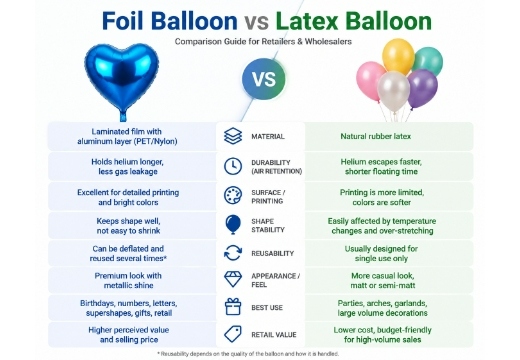 Why Foil Balloons Last Longer Than Latex Balloons: A Durability Comparison Guide
Aug 02,2026
Foil balloons and latex balloons serve different purposes in the balloon industry. This guide explains the key durability differences between foil and latex balloons, including material structure, helium retention, printing performance, reusability, and retail value. Learn why many wholesalers, retailers, and event suppliers choose foil balloons for premium product lines and how selecting the right balloon type can improve customer satisfaction and business profitability.
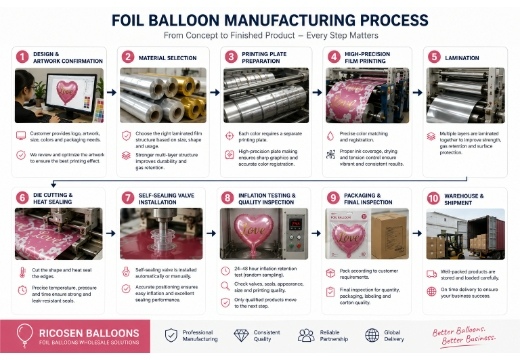 How Are Foil Balloons Made? Inside the Factory: What Happens Before a Foil Balloon Enters Mass Production
Jul 26,2026
Behind every high-quality foil balloon is a carefully controlled manufacturing process. This article takes you inside a professional foil balloon factory, explaining every stage from artwork preparation and material selection to printing, lamination, heat sealing, quality inspection, and final packaging. Learn how each production step influences balloon quality and how buyers can evaluate suppliers beyond price alone.
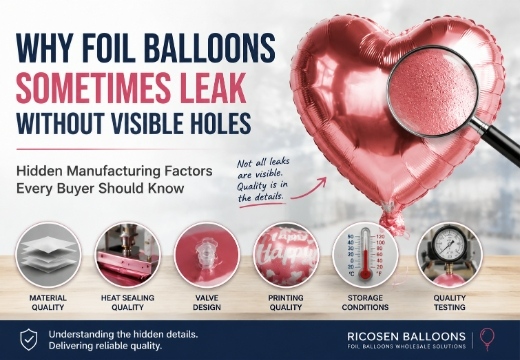 Why Foil Balloons Sometimes Leak Without Visible Holes: Hidden Manufacturing Factors Every Buyer Should Know
Jul 17,2026
Why do foil balloons leak without visible holes? This article explains the hidden manufacturing factors affecting foil balloon durability, including materials, sealing, valves, printing, storage, and quality testing. Learn how professional buyers evaluate suppliers and avoid quality problems.
 How Successful Balloon Retailers Build a Product Mix That Sells All Year
Jul 10,2026
A successful balloon business isn't built by offering the most products—it's built by offering the right mix of products.
This guide introduces the 70-20-10 Product Mix Framework, a practical approach that helps balloon retailers balance evergreen products, seasonal collections, and trend-driven items for healthier inventory, stronger cash flow, and more consistent year-round sales. Whether you're expanding your product assortment or refining your purchasing strategy, this framework offers actionable insights to build a more profitable retail business.