
How Are Foil Balloons Made? Inside the Factory: What Happens Before a Foil Balloon Enters Mass Production
A step-by-step look into foil balloon manufacturing—and why every small detail protects your retail brand.
When a buyer opens a carton of finished foil balloons, they usually evaluate three things: the vibrant colors, the crisp print, and whether the balloon holds air.
What remains invisible is the complex, precision-driven manufacturing journey behind it.
Why do some foil balloons slowly lose helium within 48 hours while others stay firm for weeks? Why do colors look vivid in one batch but washed out in the next? The answer never comes down to luck—it lies in the production process.
For wholesalers, importers, and private-label balloon brands, understanding this manufacturing path isn't just a lesson in engineering. It is one of the most practical ways to evaluate suppliers objectively, ask the right questions, and reduce costly quality issues before they happen.
Before exploring each production stage in detail, here's a simplified overview of how professional foil balloons move from concept to finished product.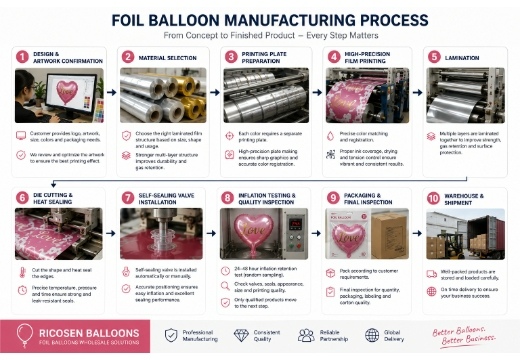
1. Product Design and Artwork Confirmation
Every custom foil balloon begins as a digital concept. Typically, buyers provide their brand logo, artwork, product dimensions, color specifications, and packaging requirements.
Before a single sheet of film is loaded onto the machine, a professional supplier carefully reviews every detail.
Printing on flexible laminated film is very different from printing on paper. Seam allowances, inflation expansion, valve placement, and cutting lines all need to be considered during artwork preparation.
A small adjustment at this stage can prevent thousands of defective products later.
Buyer Insight
Catching a design issue during digital proofing costs almost nothing. Discovering it after 50,000 balloons have been printed can delay an entire seasonal launch.
2. Strategic Material Selection
Not all foil balloons are manufactured using the same material structure.
The ideal laminated barrier film depends on balloon size, shape, inflation method (air or helium), and intended application.
Professional manufacturers select different material structures to achieve the right balance between flexibility, tensile strength, printability, and gas retention.
For oversized products such as 40-inch number balloons, stronger multi-layer laminated structures are often preferred to reduce stress during inflation and transportation.
In Our Experience
Many buyers assume balloons that look identical are made from identical materials. In reality, the internal material structure often determines how well a balloon performs weeks after it leaves the factory.
3. Precision Printing Plate Preparation
Once artwork is approved, custom printing plates are produced.
Each color normally requires its own dedicated plate.
Accurate plate preparation directly influences:
Image sharpness
Fine detail reproduction
Color registration
Production consistency
Even small errors at this stage may result in printing defects that cannot be corrected later during manufacturing.
4. High-Precision Film Printing
Printing is where the balloon begins to take on its visual identity.
Professional manufacturers carefully monitor:
Ink coverage
Printing pressure
Registration accuracy
Drying conditions
Film tension
The objective is not simply attractive graphics.
Printing must also preserve the flexibility of the laminated film after inflation.
For custom printed foil balloons, maintaining consistent brand colors between different production batches is equally important.
Buyer Insight
Consistent printing isn't only about aesthetics. It helps protect brand identity and ensures repeat orders look identical to previous shipments.
5. Lamination: The Secret Behind Long-Lasting Inflation
After printing, multiple material layers are bonded together using specialized adhesives to create the final laminated barrier film.
This process improves:
Mechanical strength
Gas retention
Surface durability
The precision of lamination directly affects how long a balloon can maintain inflation during storage, transportation, and customer use.
Poor lamination may not be visible immediately, but it can significantly reduce long-term product performance.
6. Die Cutting and Precision Heat Sealing
The printed laminated film is then cut into the balloon shape.
Heat sealing permanently joins the front and back layers while leaving an opening for the self-sealing valve.
This process depends on four critical variables:
Temperature
Pressure
Sealing time
Mold accuracy
Even slight variations can create weak sealing points.
In Our Experience
A heat seal may appear perfect immediately after production but begin to weaken several days later if sealing parameters are not consistently controlled throughout the production run.
Maintaining stable sealing performance across thousands of balloons is one of the greatest challenges in large-scale manufacturing.
Buyer Insight
Weak heat seals are one of the most common causes of slow leakage. If you'd like to understand this issue in more depth, read our guide onwhy foil balloons leak without visible holes.
7. Self-Sealing Valve Installation
Although small, the self-sealing valve plays a critical role in balloon performance.
It allows helium or air to enter smoothly during inflation while preventing gas from escaping after the inflation nozzle is removed.
Professional production lines carefully inspect valve positioning, insertion depth, and sealing performance.
Buyer Insight
Even premium laminated materials cannot compensate for a poorly installed or poorly manufactured valve. Balloon reliability depends on the performance of every component.
8. Rigorous Inflation Testing & Quality Inspection
Manufacturing doesn't end once a balloon is assembled.
Professional foil balloon quality control includes:
Inflation retention testing
Valve inspection
Seal strength testing
Random batch sampling
Appearance inspection
Dimension verification
Many manufacturers also perform 24- to 48-hour inflation retention tests before approving mass production.
Professional quality control is not simply about confirming that a balloon inflates.
It is about verifying that it continues to perform reliably after inflation.
This stage helps identify hidden defects before products reach customers.
9. Custom Packaging and Final Inspection
Once every inspection has been completed, balloons are packed according to customer specifications.
Packaging may include:
Individual retail polybags
Printed header cards
Barcode labels
Instruction sheets
Export cartons
Before shipment, a final inspection confirms product quantity, packaging accuracy, barcode readability, and overall presentation.
Proper packaging protects not only the balloon—but also the customer's brand image.
Why Small Production Steps Matter to Your Bottom Line
When suppliers are compared only by quotation price, it is easy to overlook what happens inside the factory.
Reducing material specifications, shortening inflation testing, or simplifying the sealing process may save a few cents per balloon.
For wholesalers and importers, however, those shortcuts often lead to customer complaints, returns, negative online reviews, and damaged brand reputation.
Understanding the manufacturing process helps buyers evaluate suppliers based on production capability, consistency, and long-term reliability—not simply price.
If you're still evaluating suppliers, our article on how to choose a reliable foil balloon supplier may also be helpful.
6 Questions to Ask Your Supplier Before Starting Mass Production
Before placing your next purchase order, consider asking:
How do you review artwork before production?
Which laminated material structure do you recommend for this balloon size?
How do you control color consistency between different production batches?
What is your standard inflation retention testing procedure?
What percentage of each production batch undergoes quality inspection?
How do you investigate and resolve quality issues if defects are found?
The answers quickly reveal whether your supplier truly understands manufacturing—or is simply focused on fulfilling orders.
Final Thoughts
Behind every high-quality foil balloon is a disciplined manufacturing process where every detail matters.
From artwork preparation and material selection to printing, heat sealing, quality inspection, and packaging, consistent quality is built step by step—not by chance.
At Ricosen Balloons, we believe long-term partnerships are built through transparent manufacturing processes, reliable execution, and consistent product quality.
Quality is never created during the final inspection.
It is created in every decision made before the first balloon is ever produced.
For professional foil balloon manufacturers, consistency is not a result—it's a process.
Frequently Asked Questions
How are custom foil balloons manufactured?Foil balloons are manufactured through multiple stages, including artwork preparation, material selection, printing plate production, film printing, lamination, die cutting, heat sealing, valve installation, inflation testing, and final packaging.
How long does foil balloon mass production usually take?
Production normally takes 15–30 days depending on product complexity, order quantity, and customization requirements. Custom projects may require additional time for artwork approval and printing plate preparation.
Why is inflation retention testing so important?
Inflation retention testing helps identify microscopic leakage, weak heat seals, or valve defects before products are shipped, reducing customer complaints and protecting product quality.
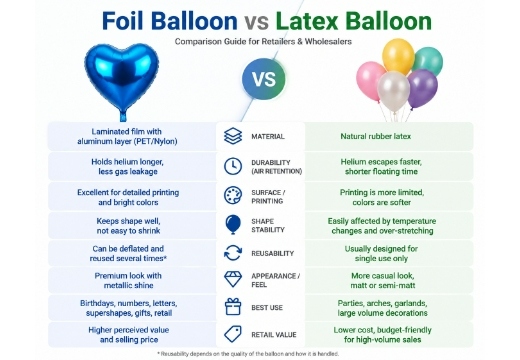 Why Foil Balloons Last Longer Than Latex Balloons: A Durability Comparison Guide
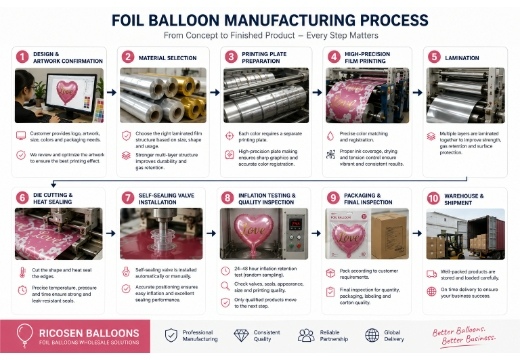 How Are Foil Balloons Made? Inside the Factory: What Happens Before a Foil Balloon Enters Mass Production
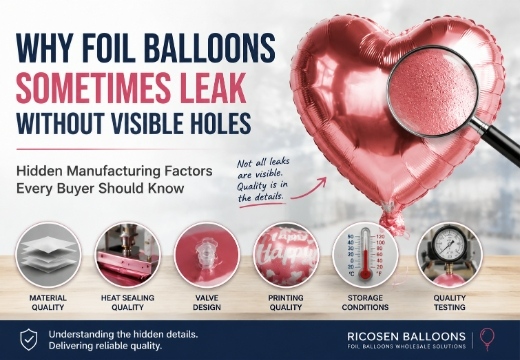 Why Foil Balloons Sometimes Leak Without Visible Holes: Hidden Manufacturing Factors Every Buyer Should Know
 How Successful Balloon Retailers Build a Product Mix That Sells All Year