
About Us
How Successful Balloon Retailers Prepare for Seasonal Sales 3–6 Months in Advance
Views : 501
Update time : 2026-06-10 16:33:14
Why Early Planning Often Matters More Than Finding the Lowest Supplier Price
Many retailers assume that a successful seasonal sales campaign starts the day inventory hits the shelves.In reality, the retailers who perform best during the season usually begin preparing months earlier.
By the time consumers start shopping for Graduation, Halloween, Christmas, or Valentine's Day, top-performing retailers have already finalized their inventory plans, display concepts, and purchasing strategies.
This gap in preparation is one reason some stores consistently sell through seasonal inventory while others struggle with stock shortages, premium shipping costs, or leftover clearance products.
The difference is rarely luck.
More often, it comes down to timing.
Why Waiting Until the Season Starts Is a Costly Gamble
One of the most common mistakes in retail is confusing consumer timing with supply chain timing.Take Graduation season as an example.
Peak retail sales often happen in April and May. If a retailer starts sourcing inventory in April, they may face limited stock availability, reduced production flexibility, and significantly higher shipping costs.
The same pattern appears across almost every major season:
Valentine's Day planning often begins in November or December.
Graduation purchasing strategies are frequently finalized in January or February.
Halloween sourcing often starts during early summer.
Christmas orders are commonly placed before the autumn rush begins.
By the time a season feels urgent in stores, many of the best purchasing opportunities have already passed.
Step 1: Review Last Year's Data Before Chasing New Trends
It is easy to get distracted by searching for the next big product trend.However, the most reliable roadmap for this year's success is often last year's sales report.
Before introducing new products, successful retailers typically review:
Which products sold fastest
Which items experienced stockouts
Which categories generated the highest margins
Which products required markdowns or clearance discounts
Many retailers are surprised to discover that a relatively small number of products often account for a large percentage of seasonal sales.
Understanding historical performance allows retailers to make more informed purchasing decisions while reducing unnecessary inventory risk.
Step 2: Secure Your Profit Core Before Chasing Hype
While new designs create excitement and attract attention, proven products often generate the majority of seasonal revenue.Experienced retailers build their seasonal inventory around dependable products that perform consistently year after year, including:
Number balloons
Letter balloons
Classic star and heart shapes
Proven color combinations
Popular event-themed designs
Only after securing this foundation do they allocate part of their budget to testing new ideas.
This balanced approach allows retailers to stay current without exposing themselves to excessive inventory risk.
Many also prioritize fast-turnover balloon products because they help maintain healthy cash flow and free up shelf space for future opportunities.
Step 3: Shift From Individual SKUs to Curated Product Groups
Managing hundreds of individual balloon SKUs can quickly become complicated.It often leads to inventory imbalances, where retailers have plenty of one item but run out of the products needed to complete a decoration package.
Successful retailers simplify operations by purchasing and merchandising coordinated product groups.
For Graduation season, many retailers increasingly rely on ready-to-sell balloon sets that combine numbers, stars, and matching colors into a complete decoration concept.
For Father's Day and other seasonal events, seasonal balloon sets help customers quickly find celebration-ready products without spending time matching individual items.
This approach simplifies:Purchasing,Inventory management,Merchandising,Reordering
Most importantly, it creates a smoother shopping experience for customers.
Step 4: Map Out Displays Before the Inventory Arrives
Inventory sitting in a warehouse does not generate sales.Effective displays do.
Many retailers spend considerable time selecting products but treat merchandising as an afterthought.
Successful retailers take the opposite approach.
Before inventory arrives, they already know:
Which store locations will feature seasonal products
Which items will be grouped together
Which themes will be promoted
Which displays will receive premium visibility
Many retailers have found that display-ready products are easier to merchandise because customers can immediately understand the final decoration concept.
When products are easy to understand, purchasing decisions happen faster and impulse purchases become more common.
Step 5: Leave Financial Room for Mid-Season Reorders
Another common mistake is spending the entire seasonal budget on the first purchase order.Even the most accurate forecast cannot predict every sales outcome.
Some products will exceed expectations.
Others will move slower than anticipated.
To maintain flexibility, many retailers reserve part of their seasonal budget for replenishment.
A common approach is:
70–80% allocated to proven seasonal products
20–30% reserved for reorders and unexpected opportunities
This allows retailers to react to actual demand rather than relying entirely on forecasts.
Step 6: Build a 12-Month Seasonal Blueprint
Consistency almost always outperforms last-minute rushing.Retailers that consistently perform well usually follow a structured approach to seasonal planning.
Instead of making purchasing decisions only when a season approaches, they map out major events months in advance.
A simplified calendar may look like this:
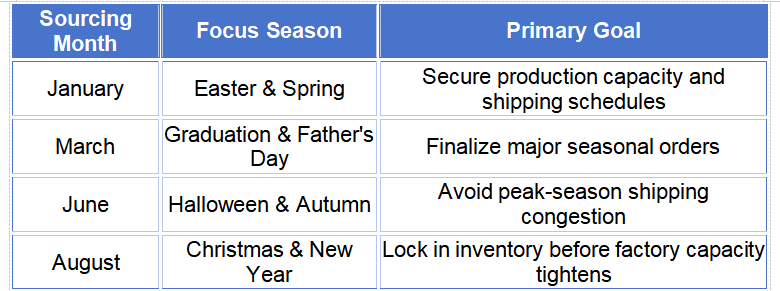
This approach creates more predictable purchasing decisions, improves inventory control, and reduces last-minute pressure throughout the year.
Overcoming the Sourcing Trap
Ultimately, seasonal success is rarely determined by finding the lowest supplier price.A lower-cost product that arrives late, misses the season, or creates quality issues often becomes more expensive in the long run.
Successful retailers focus on timing, inventory efficiency, and operational consistency.
By planning 3–6 months ahead, prioritizing high-performing product groups, and building a structured purchasing strategy, retailers place themselves in a stronger position to manage inventory, control costs, and respond to market demand.
In many cases, the most profitable seasonal decisions are made long before customers ever walk into the store.
相关新闻
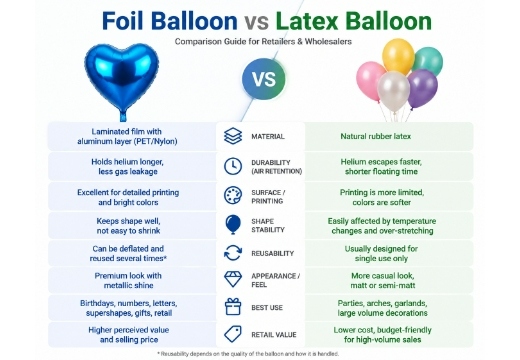 Why Foil Balloons Last Longer Than Latex Balloons: A Durability Comparison Guide
Aug 02,2026
Foil balloons and latex balloons serve different purposes in the balloon industry. This guide explains the key durability differences between foil and latex balloons, including material structure, helium retention, printing performance, reusability, and retail value. Learn why many wholesalers, retailers, and event suppliers choose foil balloons for premium product lines and how selecting the right balloon type can improve customer satisfaction and business profitability.
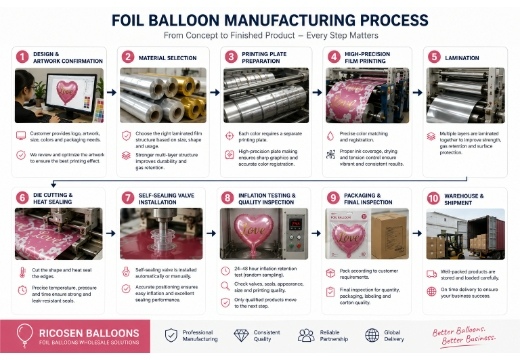 How Are Foil Balloons Made? Inside the Factory: What Happens Before a Foil Balloon Enters Mass Production
Jul 26,2026
Behind every high-quality foil balloon is a carefully controlled manufacturing process. This article takes you inside a professional foil balloon factory, explaining every stage from artwork preparation and material selection to printing, lamination, heat sealing, quality inspection, and final packaging. Learn how each production step influences balloon quality and how buyers can evaluate suppliers beyond price alone.
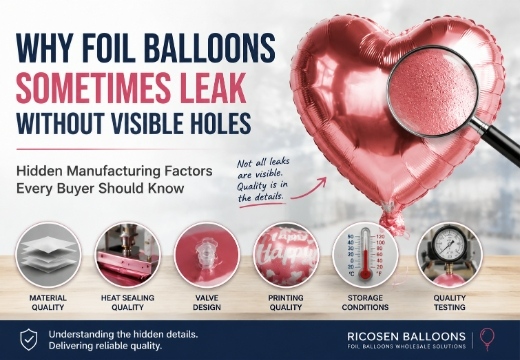 Why Foil Balloons Sometimes Leak Without Visible Holes: Hidden Manufacturing Factors Every Buyer Should Know
Jul 17,2026
Why do foil balloons leak without visible holes? This article explains the hidden manufacturing factors affecting foil balloon durability, including materials, sealing, valves, printing, storage, and quality testing. Learn how professional buyers evaluate suppliers and avoid quality problems.
 How Successful Balloon Retailers Build a Product Mix That Sells All Year
Jul 10,2026
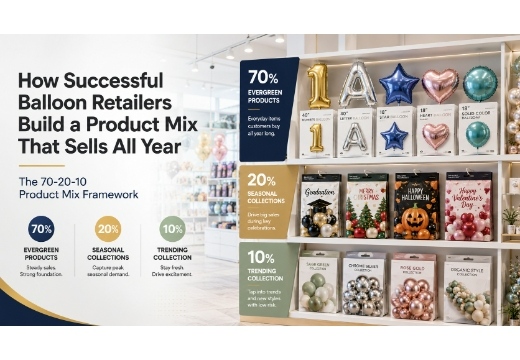
A successful balloon business isn't built by offering the most products—it's built by offering the right mix of products.
This guide introduces the 70-20-10 Product Mix Framework, a practical approach that helps balloon retailers balance evergreen products, seasonal collections, and trend-driven items for healthier inventory, stronger cash flow, and more consistent year-round sales. Whether you're expanding your product assortment or refining your purchasing strategy, this framework offers actionable insights to build a more profitable retail business.