
About Us
How Retail Buyers Reduce Inventory Risk When Choosing Balloon Suppliers
Views : 126
Update time : 2026-07-01 22:31:46
Practical strategies that help retailers avoid dead stock, improve cash flow, and build stronger supplier partnerships.
Every retail buyer has experienced this situation.A shipment arrives on time.
The products meet expectations.
The pricing looks competitive.
Yet three months later, part of the inventory is still sitting on the shelf while newer products are already being reordered.
At first glance, it seems like an inventory problem.
In reality, the root cause often lies much earlier—when the supplier was selected and the purchasing decision was made.
Experienced buyers understand that reducing inventory risk isn't about buying fewer balloons. It's about choosing suppliers that make inventory easier to sell, easier to replenish, and easier to manage.
The most successful retailers don't simply compare quotations. They evaluate suppliers based on how much uncertainty a supplier can remove throughout the purchasing process.
Price Matters—But Predictability Matters More
Many first-time buyers compare suppliers almost entirely on price.Experienced buyers think differently.
Instead of asking,
Who offers the cheapest price?
they often ask,
Which supplier is least likely to create problems six months from now?
That small shift in thinking changes almost every purchasing decision.
A slightly lower unit price means very little if it comes with inconsistent quality, unstable lead times, or slow communication.
One delayed shipment during a major selling season can easily cost more than the savings gained from a cheaper quotation.
This is why experienced buyers evaluate suppliers based on overall purchasing value rather than unit price alone.
They consider factors such as:
1.Product consistency
2.Packaging quality
3.Production reliability
4.Communication efficiency
5.After-sales support
As discussed in our article on the cheapest balloon quote, the lowest quotation is not always the lowest long-term cost.
Reliable Lead Times Protect More Than Your Schedule
Inventory planning depends on predictable delivery schedules.Retailers prepare for seasonal events months before customers begin shopping.
Imagine preparing for the Graduation season.
Your marketing materials are ready.
Retail partners have already launched promotions.
Online advertisements are running.
Customers have started placing orders.
Then your shipment is delayed by two weeks.
The problem is no longer logistics.
It becomes lost sales, disappointed customers, emergency freight costs, and inventory arriving after demand has already peaked.
Experienced buyers understand that reliable lead times don't simply improve operations—they protect inventory value.
Consistency often matters more than speed.
A supplier who consistently delivers within 30 days is usually more valuable than one who promises 20 days but regularly delivers in 35.
This approach becomes even more effective when combined with proper seasonal sales planning, allowing retailers to prepare inventory before peak demand arrives.
Successful Buyers Test Before They Scale
One habit separates experienced buyers from inexperienced ones.They rarely place large orders with a new supplier immediately.
Instead, supplier relationships usually develop step by step.
A typical process looks like this:
1.Sample evaluation
2.Small trial order
3.Performance review
4.Repeat purchase
5.Long-term partnership
Each stage reduces uncertainty.
Buyers can evaluate product quality, packaging standards, delivery performance, communication, and problem-solving ability before increasing purchasing volume.
Trust is rarely built through promises.
It is built through consistent execution over time.
Flexible Product Assortments Reduce Inventory Pressure
Inventory risk is not only about how much stock you purchase.It is also about what you choose to stock.
Suppliers offering flexible product assortments often help retailers manage inventory more efficiently than suppliers focused only on individual SKUs.
For example, many retailers are shifting toward ready-to-sell balloon sets because they simplify merchandising, increase Average Order Value (AOV), and reduce inventory complexity.
Rather than managing dozens of unrelated designs, retailers can focus on proven product combinations that work across multiple celebrations.
This approach creates cleaner displays, simplifies replenishment, and often results in faster inventory turnover.
Market Insight Is More Valuable Than Product Catalogs
Almost every supplier has a product catalog.Far fewer suppliers can explain which products are actually selling.
Experienced suppliers don't simply report what is popular today.
They recognize buying patterns before they become obvious to the broader market.
Experienced buyers appreciate suppliers who provide practical market intelligence, including:
1.Fast-growing product categories
2.Seasonal purchasing recommendations
3.Emerging color trends
4.Proven best-selling combinations
5.Retail merchandising suggestions
This information helps buyers make more confident purchasing decisions while reducing unnecessary inventory risk.
Many retailers also review best-selling balloon products before finalizing seasonal purchasing plans, using previous sales performance to make more informed buying decisions.
Common Purchasing Mistakes That Increase Inventory Risk
Many inventory problems don't begin in the warehouse.
They begin during supplier selection.
Some of the most common mistakes include:
1.Choosing suppliers based only on price.
2.Ordering too many new designs without sales history.
3.Ignoring seasonal purchasing windows.
4.Underestimating production lead times.
5.Failing to review reorder performance.
Each decision may appear small on its own.
Together, however, they can create excess inventory, reduce cash flow, and make future purchasing decisions far more difficult.
Avoiding these mistakes is often more valuable than finding the "perfect" product.
Strong Suppliers Help Buyers Make Better Decisions
The best suppliers don't simply manufacture balloon products.They reduce uncertainty before it becomes inventory.
They recommend proven product combinations instead of pushing every new design.
They provide realistic production schedules instead of unrealistic promises.
They share market feedback instead of generic sales pitches.
They help buyers understand which products are most likely to generate repeat orders.
Over time, these small actions reduce inventory risk far more effectively than chasing the lowest quotation ever could.
Many experienced buyers also rely on a structured balloon purchasing sheet to compare suppliers objectively and make purchasing decisions based on measurable factors rather than assumptions.
Final Thoughts
Inventory risk is rarely created overnight.It develops gradually through dozens of purchasing decisions—choosing the wrong products, ordering at the wrong time, relying on unrealistic lead times, or working with suppliers who simply manufacture rather than advise.
Experienced retail buyers understand that successful sourcing isn't about eliminating every risk.
It's about reducing uncertainty before the purchase order is even placed.
Because inventory doesn't become risky when it enters the warehouse.
It becomes risky the moment the wrong purchasing decision is made.
Related Articles
How Successful Balloon Retailers Prepare for Seasonal Sales 3–6 Months in AdvanceWhy the Cheapest Balloon Quote Is Often Your Most Expensive Sourcing Mistake
Why More Retailers Are Choosing Ready-to-Sell Balloon Sets Over Individual SKUs
Why Some Balloon Products Become Best Sellers While Others Sit on Shelves
相关新闻
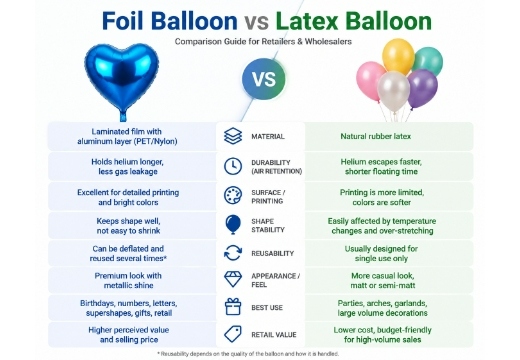 Why Foil Balloons Last Longer Than Latex Balloons: A Durability Comparison Guide
Aug 02,2026
Foil balloons and latex balloons serve different purposes in the balloon industry. This guide explains the key durability differences between foil and latex balloons, including material structure, helium retention, printing performance, reusability, and retail value. Learn why many wholesalers, retailers, and event suppliers choose foil balloons for premium product lines and how selecting the right balloon type can improve customer satisfaction and business profitability.
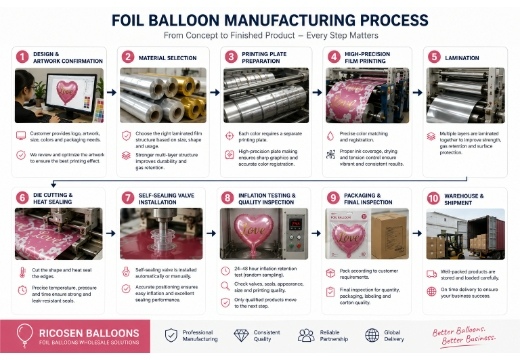 How Are Foil Balloons Made? Inside the Factory: What Happens Before a Foil Balloon Enters Mass Production
Jul 26,2026
Behind every high-quality foil balloon is a carefully controlled manufacturing process. This article takes you inside a professional foil balloon factory, explaining every stage from artwork preparation and material selection to printing, lamination, heat sealing, quality inspection, and final packaging. Learn how each production step influences balloon quality and how buyers can evaluate suppliers beyond price alone.
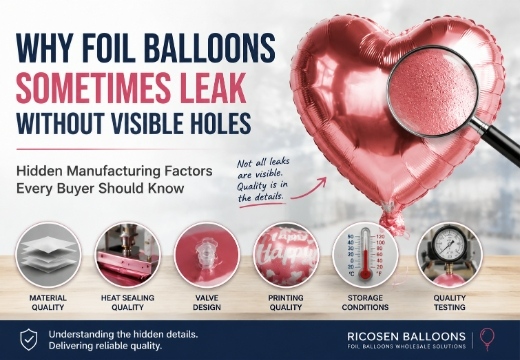 Why Foil Balloons Sometimes Leak Without Visible Holes: Hidden Manufacturing Factors Every Buyer Should Know
Jul 17,2026
Why do foil balloons leak without visible holes? This article explains the hidden manufacturing factors affecting foil balloon durability, including materials, sealing, valves, printing, storage, and quality testing. Learn how professional buyers evaluate suppliers and avoid quality problems.
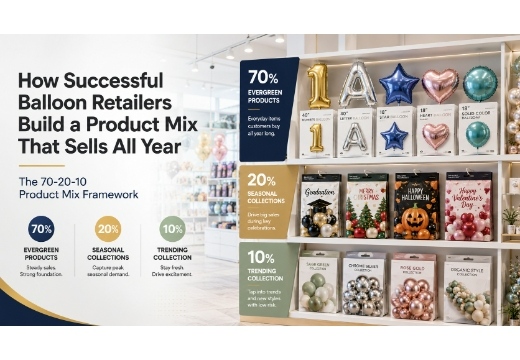 How Successful Balloon Retailers Build a Product Mix That Sells All Year
Jul 10,2026
A successful balloon business isn't built by offering the most products—it's built by offering the right mix of products.
This guide introduces the 70-20-10 Product Mix Framework, a practical approach that helps balloon retailers balance evergreen products, seasonal collections, and trend-driven items for healthier inventory, stronger cash flow, and more consistent year-round sales. Whether you're expanding your product assortment or refining your purchasing strategy, this framework offers actionable insights to build a more profitable retail business.